The Complete Guide to Pitch Deck Clarity
Navin Mangalat

Most pitch decks fail not in the meeting but before it.
They fail on the first skim: 60 seconds during which an investor decides whether to engage or move on.
They fail on the re-read: the cold read a partner does after receiving a forwarded deck with no context.
They fail when the investor tries to describe the company to a colleague and can’t reconstruct the argument without the founder present.
These are not design problems. They are clarity problems. And they have a different set of causes (and a different set of fixes) from the problems most founders focus on.
This guide covers the complete model of pitch deck clarity. It is built from six posts in the Pitch Clarity cluster, each addressing one specific failure mode. This guide synthesises them into a single framework and provides a self-assessment tool you can run on your own deck.
The Retell Standard: The Framework Behind This Guide
The Retell Standard is the clearest definition of what clarity actually means in a pitch deck context.
A pitch deck passes the Retell Standard when a cold reader, i.e., someone with no prior context, can, after a single read, accurately answer three questions without the founder present:
What is this? Who is it for? A specific description of the company and the customer - specific enough that the investor can picture who benefits and what changes for them.
Why should I believe it? At least one concrete, specific signal that the company is real and the problem is being solved for someone, placed early enough to have shaped rather than fought the investor’s initial view.
What should happen next? A clear, specific call to action with enough urgency that “later” is not the default response.
When any one of these three questions gets a vague answer, the deck has failed the Retell Standard. The failure mode is diagnosable; the question that fails tells you which type of clarity problem you’re dealing with.
Most pitch decks fail on at least one question. The typical failure pattern:
Question 1 fails: The one-liner is too broad, slide 1 doesn’t orient quickly, or the opening arc doesn’t establish context before the investor forms a prior impression.
Question 2 fails: Evidence arrives too late, isn’t specific enough to be interpreted, or isn’t adjacent to the claim it supports.
Question 3 fails: No timing argument, no explicit ask, or a next step so vague that deferral is the path of least resistance.
Part 1: How a Deck Gets Read, and Where It Fails
Most founders assume the deck is read linearly, once, with consistent attention. Most decks are encountered in at least three modes, each making different demands on the material.
Mode 1: The Skim (60–90 seconds)
When an investor first opens a deck, they are not reading; they are scanning. They’re looking for answers to three questions before deciding whether this warrants a careful read: what is this, does it look real, and is there a reason to keep going?
The scan moves across slide headlines, dominant visual elements, and any concrete number or specific claim that registers at a glance. Dense body text, detailed explanations, anything requiring more than a second to understand - all of it is effectively invisible on the first pass.
A deck that fails the skim fails before it gets a careful read. The content in the second half, including most of the evidence, never gets seen.
Mode 2: The Careful Read (5–15 minutes)
If the deck passes the skim, the investor reads more carefully, though still not uniformly. Attention concentrates on the opening sequence, on the evidence, and on the ask. It drops across detailed product descriptions, long market analyses, and anything that reads as filler.
The careful read is where the full argument either builds conviction or fails to. The determining factors: whether slide 1 orients quickly, whether the opening three slides establish credibility before the investor’s view has hardened, and whether the evidence is placed where it shapes the initial hypothesis rather than arriving after it has settled.
Mode 3: The Re-Read (without the founder)
This is the mode most founders don’t account for, and the one most likely to explain post-meeting silence.
After a first meeting, the deck gets re-read. Sometimes the investor re-reads it themselves to consolidate their view. More often, a partner reads it cold; the investor has forwarded it with a brief note and no context, and the partner is seeing it for the first time.
In this mode, everything the founder said in the meeting is gone. The narrative context, the verbal explanation of evidence, the emphasis on the most important metric - none of it travels. The deck has to make the case without the founder. Every gap the founder filled verbally in the meeting becomes a gap in the cold read.
The deck that passes Mode 3 is the deck that never needed the founder to explain it. It orients without preamble, establishes credibility with specific early evidence, and closes the argument without depending on live presentation.
Part 2: The Clarity Problems: A Diagnostic Map
Each of the relevant problems is covered in the six posts below. The table below shows how they relate to the three reading modes and the three Retell Standard questions.
Clarity problem | Mode affected | Retell question broken | Post |
|---|---|---|---|
Key message not visible in 60-second scan | Mode 1: Skim | All three; skim failures prevent the argument from being seen | |
Slide 1 doesn’t orient in five seconds | Mode 2: Careful read | Q1: What is this? | |
Opening arc doesn’t credentialise before the view hardens | Mode 2: Careful read | Q1 + Q2 | |
Deck requires founder present to fill structural gaps | Mode 3: Re-read | All three; gaps close only with verbal explanation | Why your pitch falls apart when forwarded |
Excess slides dilute signal, bury evidence | Modes 2 + 3 | Q1 + Q2 | |
Length optimised for slide count rather than signal density | Modes 2 + 3 | Q2; evidence gets buried |
Reading the map: The problems in the top half of the table happen before the investor reaches most of the deck’s content. These are the highest-leverage fixes: getting the opening right means the evidence gets a fair read. The problems in the bottom half happen across the whole deck and often share a root cause: the deck was built for the founder’s knowledge of the company, not for a cold reader encountering it for the first time.
Part 3: The Opening Sequence: Where the Most Valuable Work Happens
The most important three slides in any pitch deck are the first three. Not because they contain the most information, but because they determine whether the rest of the deck gets a fair read.
The opening arc has three jobs before the investor reaches slide four:
Orient. The cold reader knows what the company does and who it’s for, quickly, without effort. Not a category, not a vision statement, not a product description. A specific outcome for a specific type of person.
Credentialise. Before the investor forms a skeptical view, there is one concrete signal that the company is real: a specific customer outcome, a usage signal, a result specific enough to believe. It doesn’t require a dedicated traction slide. It requires one thing real enough to say, “This is not just a concept.”
Create forward momentum. Something in the first three slides gives the investor a reason to keep reading, through a combination of clarity and early credibility that makes the rest feel worth the time.
Slide 1 has a single job within the arc: orient in five seconds. The arc’s credentialise and momentum jobs belong to slides two and three. Getting slide 1 right is a necessary but not sufficient condition for a working opening arc. A perfect slide 1 followed by two slides of feature descriptions still fails the credentialise job and leaves the investor without the early belief anchor they need before their view settles.
The inverse failure is also common: a deck that credentialises on slide two but doesn’t orient on slide one. The investor gets an impressive metric before they understand what the company does, which produces confusion rather than conviction. Orientation must come first; credibility follows.
Part 4: Slide-Level vs Deck-Level Clarity
Two distinct levels of clarity problems need addressing because they require different types of work.
Slide-level clarity is about whether individual slides are doing their job clearly: slide 1 orients in five seconds; headlines make specific claims rather than labelling sections; metrics have timeframes and baselines; the one-liner names a customer and an outcome. These problems are often self-fixable with the right framework. The five-second test, the headline-as-claim test, and the context test are all immediately applicable.
Deck-level clarity is about whether the deck works as a sequence: slides in the right order, evidence in the right position, argument flowing toward conviction rather than just presenting information. Deck-level problems are harder to see from inside the material, because founders have internalised the argument. The sequence that feels obvious to someone who knows the company is often opaque to a cold reader.
The relationship between the two levels is not simply additive. A deck where every slide is individually clear, but the sequence is wrong, gives a cold reader clear signals that add up to a confused overall argument. Conversely, a deck with a strong sequence but unclear individual slides loses investors on the skim before the sequence can work.
The practical priority order: Fix deck-level problems first (sequence, placement, arc), then fix slide-level problems (headline claims, one-liner, context). Slide-level fixes done before the sequence is right often get undone when the sequence changes.
Part 5: The Retell Standard Applied: A Worked Example
The Retell Standard is most useful when you can see it failing, and failing in a specific, diagnosable way. The following illustrative example shows how a founder would run a deck through the three questions and identify where it breaks.
The deck:
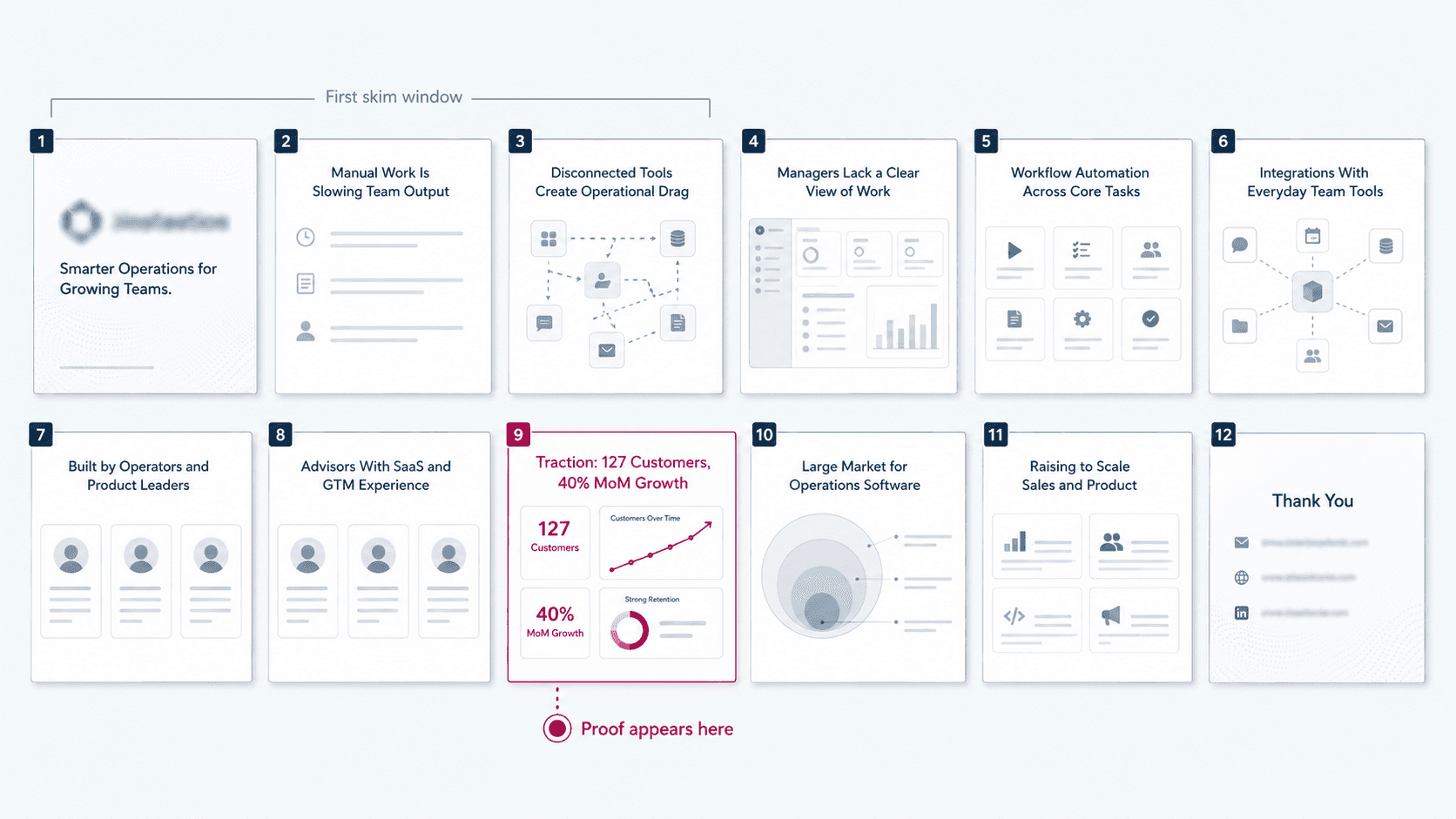
For illustrative purposes only.
Question 1: What is this? Who is it for?
A cold reader was asked what the company does after one read: “Something about operations software for teams? Not sure exactly who uses it.”
Q1 is failing. “Smarter Operations for Growing Teams” is a category description, not a customer-and-outcome statement. The cold reader can’t picture the customer or name what changes for them.
The specific problem: Slide 1 is doing a tagline job, not an orientation job. The fix: replace the tagline with a one-liner naming the customer (“operations managers at Series A-stage SaaS companies”) and the outcome (“who reduce weekly manual reporting from 8 hours to under 45 minutes”).
Question 2: Why should I believe it?
Asked what the most convincing piece of evidence was: “There were some numbers on slide 9 - 127 customers and 40% growth, I think. But I’d already lost the thread by then.”
Q2 is failing for two reasons. The strongest evidence appears on slide 9, after the investor has formed a view across eight slides with no credibility anchor. And the metric lacks context: 40% MoM growth from what base? 127 customers in how long?
The specific problems: Late placement (Mode 2 failure) and a context failure that makes the metric uninterpretable. Two fixes: move one concrete customer signal into the opening arc (slide 2 or 3), and add a timeframe and baseline to the traction metric.
Question 3: What should happen next?
Asked what they’d do next as a seed investor: “Reach out to learn more, I suppose. The slide said something about raising, but wasn’t specific.”
Q3 is partially failing. There’s an ask, but no amount, no use of funds, no timing argument. “Later” becomes the default response.
The specific problem: The ask slide exists but is underspecified. The fix: name the raise amount, state the use of funds at a high level, and, if there’s a timing argument, name what specifically makes now the right moment.
What this shows:
Three distinct failure modes in one deck - orientation (Q1), placement and framing (Q2), ask specificity (Q3) - each diagnosable from the specific Retell question that fails. The deck isn’t fundamentally broken; it has clear, fixable, prioritised problems.
How should you prioritize this?
Q1 is the most urgent fix. A cold reader who can’t describe the company accurately on slide 1 is forming the wrong prior impression before the evidence arrives.
Q2 is the second priority - move the evidence earlier, add context to the metric.
Q3 is the third. Getting Q1 and Q2 right first means Q3 lands in a deck the investor already wants to act on.
Part 6: The Length and Signal Density Question
Deck length is often treated as a rules question (“how many slides?”) when it is actually a signal density question: is every slide earning its place, or are some making the message harder to find?
The two variables interact in a specific way. A long deck doesn’t just take more time to read: it reduces signal density. Every slide that isn’t doing a specific, necessary job dilutes the slides that are. An investor who reaches the strongest evidence on slide fourteen has spent thirteen slides forming a view without the benefit of that evidence.
This is why cutting is directly connected to placement. Excess slides push strong evidence later. Removing those slides doesn’t just shorten the deck; it moves the evidence earlier in the sequence, where it needs to be to shape the investor’s hypothesis rather than fight it.
Before asking “how long should my deck be?” ask “which slides are doing a specific, necessary job for a cold reader?” The deck is the right length when removing any slide would leave a genuine gap. Everything else is excess that makes the message harder to find.
Part 7: The Clarity Self-Assessment
Apply this tool to your deck before investor conversations. Work through each section with your deck open. Do not fill in what you think is true. Answer based on what a cold reader would actually experience.
Check 1: The Skim Test (60 seconds)
Send the deck to someone unfamiliar with your business. Ask them to spend 90 seconds scanning (not reading) then cover it.
Ask:
What is this company?
What was the most convincing thing they noticed?
What would they do next?
Result | Diagnosis | Priority action |
|---|---|---|
Specific, accurate answers to all three | Skim-safe | Move to Check 2 |
Accurate on Q1; Vague on Q2 and Q3 | Evidence and next step are buried | Move strongest evidence earlier; make the ask explicit |
Vague or inaccurate on Q1 | Key message not visible on scan | Fix headline claims and visual hierarchy first |
Check 2: The Slide 1 Test (5 seconds)
Show slide 1 to someone unfamiliar with the company. Five seconds. Cover it.
Ask:
What does this company do?
Who is it for?
Result | Diagnosis | Priority action |
|---|---|---|
Specific answer naming customer and outcome | Slide 1 is orienting | Move to Check 3 |
Category description or vague answer | Slide 1 is doing something other than orienting | Replace with a one-liner stating outcome for specific customer, made visually dominant |
Blank or confused | Slide 1 is information-dense or concept-first | Remove everything that requires context to understand |
Check 3: The Opening Arc Test
Cover slides four onwards. Show only the first three slides to someone without context. Ask three questions:
What does this company do, and who is it for?
Is there anything in these three slides that makes the company feel real (not just plausible)?
Do you want to keep reading?
Result | Diagnosis | Priority action |
|---|---|---|
Yes, yes, yes | Opening arc is working | Move to Check 4 |
Yes to Q1, no to Q2 | No early credibility anchor | Move most specific evidence signal into opening arc |
Yes to Q1 and Q2, hesitation on Q3 | Arc not creating forward momentum | Check whether slide 3 leaves a clear picture of a company worth backing |
No to Q1 | Orientation failing | Fix slide 1 first (Check 2), then return |
Check 4: The Forwarding Test
Send the deck with no email, no context, and no verbal briefing to someone who doesn’t know the company. Ask them to read it once and answer:
What does the company do?
What was the most convincing evidence?
What should happen next?
This is stricter than the skim test. The question is whether the deck can make the full case without the founder.
Result | Diagnosis | Priority action |
|---|---|---|
Clear, specific answers to all three | Deck is self-explanatory | Move to Check 5 |
Clear on “what it does,” vague on evidence and next step | Deck explains but doesn’t convince independently | Identify where founder would have explained; close each gap structurally |
Required follow-up questions to understand | Deck relies on live explanation | Structural rewrite. Self-explanation is the primary problem |
Check 5: The Cutting Test
Go through each slide and ask: if this slide were removed, would a cold investor lose a piece of the argument they actually need?
Mark each slide: Earns its place or Candidate to cut.
Count the candidates. More than two or three candidates means signal density is lower than it should be.
Result | Diagnosis | Priority action |
|---|---|---|
Zero or one candidates | Every slide is earning its place | Move to Check 6 |
Two or three candidates | Minor excess; targeted cuts will help | Apply cutting framework; move candidates to appendix |
Four or more candidates | Significant excess diluting signal | Systematic cutting exercise; rebuild around the argument |
Check 6: The Length Calibration Test
Ask: did each slide in this deck arrive because it was deliberately constructed to do a specific job, or because it was added at some point and never removed?
If the deck has grown through accumulation over time, i.e., slides added to address investor questions, cover new products, respond to feedback, etc., it is almost certainly longer than it needs to be.
Result | Diagnosis | Priority action |
|---|---|---|
Every slide was placed deliberately | Length is calibrated | Self-assessment complete |
Several slides exist through accumulation | Deck has grown beyond its job | Apply Check 5 more rigorously; use signal-density test |
Reading the Self-Assessment Results
Checks 1–3 fail: The opening is where the deck is losing investors. These are the highest-leverage fixes. They determine whether the rest of the deck gets a fair read at all.
Checks 1–3 pass, Check 4 fails: The deck works in presentation mode but falls apart in re-read mode. The fix is structural: find and close the gaps the founder fills verbally.
Checks 1–4 pass, Checks 5–6 fail: Clarity is coming through, but signal density is off. Evidence may be taking longer to arrive than it should. Cuts will help.
All checks pass, investor responses still cautious: The problem is likely not in the deck’s clarity mechanics. See “Where to Go From Here” below.
Symptom-to-Cause Quick Reference
Use this table alongside the self-assessment when you have a specific investor response pattern and want to identify the most likely clarity cause without running all six checks.
Investor response pattern | Most likely clarity cause | First check to run | Related posts |
|---|---|---|---|
“Interesting. I’ll be in touch” but no follow-up | Deck fails Mode 3 (re-read without founder) or evidence placed too late | Check 4 (forwarding test), then Check 3 | Why Your Pitch Makes Sense in the Room But Falls Apart When Forwarded The Opening Arc: How the First Three Slides Determine Whether Investors Keep Reading |
Investor seemed engaged in meeting but partner pass | Deck doesn’t make the case without the meeting’s verbal explanation | Check 4 (forwarding test) | Why Your Pitch Makes Sense in the Room But Falls Apart When Forwarded |
Investors ask the same questions the deck already answers | Deck doesn’t communicate those answers legibly on a scan | Check 1 (skim test) | |
Feedback varies wildly across investors | No clear Q1 answer. Different investors are reading different things | Check 2 (slide 1 test), then Check 3 | What Slide 1 of Your Pitch Deck Needs to Do The Opening Arc: How the First Three Slides Determine Whether Investors Keep Reading |
Investors lose interest partway through the meeting | Opening arc failing. No credibility anchor before the investor’s view settles | Check 3 (opening arc) | The Opening Arc: How the First Three Slides Determine Whether Investors Keep Reading |
Deck feels “fine” but doesn’t convert | Multiple light failures across all six checks. Signal density is low | All six checks in order | What to Cut From Your Pitch Deck (And How to Decide) How Long Should a Pitch Deck Be? (And Why the Answer Isn’t a Number) |
Revised the deck multiple times; investor response unchanged | Revisions addressed symptoms, not structural causes | Check 4 (forwarding test), then professional audit | Why Your Pitch Makes Sense in the Room But Falls Apart When Forwarded When to Get a Pitch Deck Audit, and What a Good One Should Include |
Glossary
Retell Standard:The test a pitch deck must pass: a cold reader, after a single read without the founder present, can accurately answer
what is this and who is it for,
why should I believe it, and
what should happen next.
A deck that fails any one of these questions has a clarity failure.
Cold reader: Someone with no prior context about the company who reads the deck once, without briefing, without the founder present. The cold reader is the relevant test subject for all clarity checks. Investors who haven’t yet met the founder, partners reviewing forwarded decks, and colleagues asked to give an opinion are all cold readers.
Skim: The first 60–90 seconds of a deck read, during which the investor scans for orientation, credibility, and a reason to continue. Only slide headlines, dominant visual elements, and specific claims that register at a glance are visible on a skim. Everything requiring more than a second to process is effectively invisible.
Opening arc: The first three slides of the deck, understood as a single persuasion unit with three jobs: orient the reader (who is this for and what changes for them), credentialise (one concrete signal the company is real), and create forward momentum (a reason to keep reading). The arc fails when any one of these three jobs isn’t completed before the investor reaches slide four.
Forwarding failure: The failure mode where a deck that works in a live meeting falls apart when forwarded. Caused by structural gaps the founder fills verbally in the meeting, i.e., narrative context, emphasis, explanation of evidence, etc., that don’t exist in the document. The deck relies on the founder to function; in re-read mode, without the founder, it fails to make the case.
Skim failure: The failure mode where the key message isn’t visible during the initial 60–90 second scan. Caused by buried headlines, evidence hidden in body text, and a layout that doesn’t guide the eye to what matters. A deck that fails the skim doesn’t get a careful read.
Signal density: The ratio of slides doing specific necessary work to slides that exist by accumulation or to demonstrate thoroughness. High signal density means every slide is earning its place. Low signal density means the argument is diluted by content that doesn’t advance it.
Deck-level clarity: Whether the deck works as a persuasion sequence: slides in the right order, evidence in the right position, argument flowing toward conviction. Contrasted with slide-level clarity.
Slide-level clarity: Whether individual slides are doing their specific jobs clearly: slide 1 orients in five seconds, headlines make claims rather than label sections, and metrics have context. Contrasted with deck-level clarity. Slide-level problems are usually more tractable than deck-level problems but are lower-leverage if the sequence is wrong.
Five-second test: The test for slide 1: after five seconds of exposure to slide 1, can a cold reader name the customer and the outcome? Pass means slide 1 is orienting. Fail means slide 1 is doing a different job first — brand, vision, product description, or information overload.
If you’ve worked through the self-assessment and want an outside view of which clarity problems are affecting your specific deck, the post on pitch deck audits describes what a structured review delivers and when it’s the right next step.
The Posts in This Guide
Why Your Pitch Makes Sense in the Room But Falls Apart When Forwarded
Four structural causes of forwarding failure, the cold-reader test, and what it takes to build a deck that works without the founder present.
What to Cut From Your Pitch Deck (And How to Decide)
The cutting framework and the four most common types of slides that should be cut or moved to the appendix.
The Opening Arc: How the First Three Slides Determine Whether Investors Keep Reading
The three jobs the opening sequence must accomplish (orient, credentialise, create forward momentum) and the three most common failures.
Why Your Pitch Fails on the Skim, and What to Do About It
How investors scan a deck, four ways to make a deck skim-safe, and the distinction between skim failure and forwarding failure.
What Slide 1 of Your Pitch Deck Needs to Do
The five-second orientation standard, i.e., the single job of the first slide, four failure modes, and what a working slide 1 looks like
How Long Should a Pitch Deck Be? (And Why the Answer Isn’t a Number)
The signal-density principle, i.e., why slide count is the wrong metric and how to apply the removal test to find the right length.
Where to Go From Here
Pitch deck clarity is the foundation. A clear deck can be read, understood, and forwarded without the founder. But clarity alone doesn’t create investor conviction; that requires the right evidence in the right form (Pillar 3) and a message calibrated to investor psychology and the specific expectations of the raise stage (Pillar 2).
If the self-assessment reveals a clarity failure, start with the specific post that addresses the failure mode. Each provides a targeted, self-executable framework.
If all clarity checks pass, but investor responses are still cautious, the problem is likely something else:
Symptom | Likely layer | Diagnostic resource |
|---|---|---|
Evidence is present, but not creating conviction | Evidence mechanics: type, placement, framing | |
Meetings are going well, but second meetings don’t come | Investor communication: the deck can’t sustain conviction without the founder | |
“Interesting” consistently, but no follow-up action | Gap between attention and conviction: timing argument, one-liner, or ask | |
Deck works with some investors but not others | Stage mismatch or wrong investor target | (stage calibration) |
Not sure which layer | Use the quiz |
Navin has spent nearly two decades helping founding teams and operators turn complex inputs into clear, credible stories - working across investor materials, strategic communications, and decision-ready documents where clarity and evidence placement directly affected outcomes.